This is the second article in our Inside the Xelect Lab series, where we take a closer look at the science behind what we do. In our first article, we introduced the lab and how it supports aquaculture genetics programmes around the world.
In this article, Dr Paolo Ruggeri, Senior Scientific Officer at Xelect, takes a closer look at SNP markers, what they are, how they work and why they matter so much in aquaculture.
What SNP markers are and why they matter in aquaculture?
DNA is the genetic material that carries the full set of instructions for how all organisms (including aquaculture species) grow, develop, and function. One helpful way to think about DNA is like a family cookbook, filled with recipes that are passed down through time. It is made up of four chemical bases: A (adenine), T (thymine), C (cytosine), and G (guanine) – which act like the letters in a cookbook, they are arranged in long sequences, forming the recipe. Just like a favourite family cookbook being passed down through generations, DNA can be transferred from parents to offspring, and with it, all the genetic “recipes” that determine traits associated with it.
Just like old recipes, DNA can have small mistakes or typos. Most of these changes make little or no difference to the end result. Occasionally, a mistake could be big enough to spoil the whole recipe, like adding salt to a cake batter instead of sugar, making the cake inedible.
In genetics, any fragment of DNA that can allow scientists to identify species, populations, family groups or traits associated with specific individuals are defined as molecular markers. As mentioned above, these markers can vary depending on 1) the way they are inherited, 2) their location in the genome of an organism or 3) the type of information that they carry with them.
Among the most useful molecular markers, and the marker of choice in the Xelect lab are Single Nucleotide Polymorphism markers (SNPs), which are small genetic differences (or “typos”) found in the DNA of living organisms.
What exactly is a SNP?
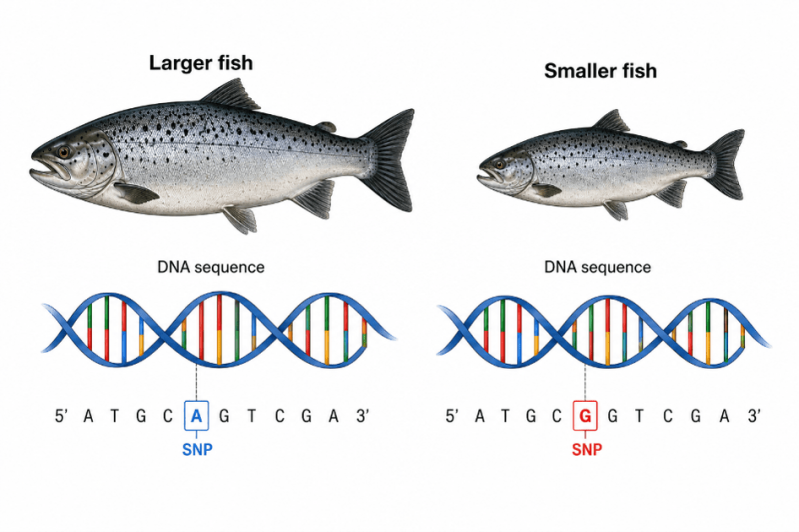
A SNP (pronounced “snip”) happens when just one of these letters at a specific position in the DNA code is different between individuals. For example, most individuals within a species may have an “A” at one position in their DNA, but some individuals may have a “G” at that very same position. It’s a tiny difference, just one base out of millions, but it carries a wealth of information.
Fig. 1 A SNP represents a signal nucleotide change at a specific position in the DNA code. Some SNPs can be linked to commercially important traits such as growth.
Some SNPs affect how a gene works and may influence body or physiological traits like growth and survival. Others don’t directly affect a trait, but they still act as a marker for establishing relatedness among individuals because it is inherited from both parents. Either way, SNPs become powerful signposts across the genome.
SNP markers are very useful because:
- They are common throughout the genome so we can study many parts of the genome in detail
- They are stable and inherited in predictable ways
- Modern laboratory technologies (e.g., DNA sequencing) make them fast and reliable to measure, even at a large scale
Why are SNPs so valuable in aquaculture?
Aquaculture is one of the fastest-growing food production sectors in the world. It plays a major role in providing protein and supporting food security for a growing global population. Genomics and particularly the usage of SNPs markers are helping aquaculture to improve productivity through increased resilience, growth, tolerance to environmental shifts and maintaining the genetic diversity required to sustain improvements for many generations to come.
Traditional breeding methods, which rely only on observing physical traits, may not always accurately preserve the desired traits. These traits are often influenced by both genetics and the environment. For example, a fish may grow larger because of a combination of good genes but also because it had better access to specific environmental conditions.
When the traits of interest are associated with the variation at specific SNP marker, genetic information can significantly enhance the precision of selection alongside traditional pedigree-based breeding methods. As a result, SNPs can be used at the same time to 1) outline the kinship among individuals reared in the same space and 2) to identify individuals with SNPs variants (alleles) linked to key traits in aquaculture. In a whole this potential use for SNPs in aquaculture is called selective breeding.
Selective breeding involves primarily choosing the best individuals to be parents of the next generation. Historically, farmers selected breeders based on visible traits such as size or survival, but this often led to selecting related individuals (e.g. brothers and sisters), as those desirable traits were inherited from common ancestry.
By analysing genetic marker like SNPs across the genome, we can more accurately estimate an individual’s genetic breeding value (EBV) and the levels of consanguinity (which means estimating how likely is that two individuals share a common ancestor).
Genomic selection methods are divided into Marker-assisted selection (MAS) and Genomic selection (GS). Marker-assisted selection (MAS) uses a few specific DNA markers, often linked with specific traits that are controlled by single genes, like disease resistance to some pathogens (e.g, resistance to Infectious Pancreatic Necrosis Virus (IPNV) in the Atlantic salmon). Genomic selection (GS) scales this up by analysing thousands of SNPs across the entire genome to predict complex, multi-gene traits like growth rate (e.g., how big a fish can grow), feed efficiency intake/ conversion ratio (e.g., genes that control metabolism and allow to keep fish growth steady while reducing food intake) or reproductive performance (e.g., egg size, fecundity and timing of sexual maturation). Both methods allow breeders to identify the best animals at an early stage, dramatically speeding up aquaculture improvements.
Particularly, Genomic selection (GS) enables breeders to choose parents with the strongest genetic potential, managing to keep a high genetic diversity while minimizing the risk for crossing closely related individuals (inbreeding). We can measure an individuals’ kinship through charting the portion of common genetic variants among individuals analysed simultaneously by SNP data. This genetic technique is named Parentage. and offers several advantages in aquaculture which include:
- Designing breeding programmes that reduce inbreeding to maintain a healthy and diverse population. Inbreeding often leads to reduced growth, fertility, and survival of offspring.
- Removing the need for families to be reared separately – and the problems that segregate rearing can pose especially for short-generation time breeding programmes.
With the modern-day opportunities permitting easy and inexpensive DNA sequencing, it is nowadays possible to design studies that allow the identification of SNP markers that are linked with specific traits of commercial relevance in (virtually) any species. These studies are collectively called Genome Wide Association Studies (GWAS) and these are the key-method to discover candidate functional SNPs markers. Accurate GWAS designing and the application of the functional SNPs derived from GWAS testing is of extreme relevance in selective breeding. This offers new ways to implement Marker-assisted (MAS) and Genomic Selection (GS) methods in aquaculture. Here below some examples of how GWAS and selective breeding can enhance aquaculture:
1. Strengthening Disease Resistance
Disease resistance, as already mentioned above, is particularly important in aquaculture, as disease outbreaks can lead to significant economic losses and high mortality rates. By using SNP markers, researchers can identify genetic differences associated with resistance against specific pathogens. For example, if certain SNP patterns are more common in fish that survive a disease outbreak, these markers can be used to select more resistant animals for breeding. Over time, this approach helps to select candidates healthier and more resilient farmed populations.
2. Adapting to Environmental Change
SNP markers also support research into adaptation to climate change (e.g. recurrent El Niño heatwaves or progressive ocean acidification). Large and sudden variations in water temperature, oxygen levels, and salinity can be deeply tightened with mortality levels in aquatic animals, with dramatic results in aquaculture production. Some individuals may carry genetic variations that allow them to better tolerate heat or low oxygen conditions. By identifying SNPs linked to these traits, breeders can develop strains that are more resilient to changing environmental conditions, especially in the current climate change.
3. Traceability and Stock Identification
Another important application is traceability and stock identification. SNP markers can help identify the origin of farmed or wild fish. This is useful for managing wild fisheries, protecting endangered populations, and verifying seafood products in the market. In some cases, SNPs can distinguish between different strains or breeding lines within the same species, helping to limit the possibility for illegal trade of patented strains by unauthorised farmers.
Final Thoughts
In summary, SNPs are small differences in DNA that can be used to study genetic variation. Even though each SNP represents only a one-letter change, together they provide detailed information about the genome. In aquaculture, SNP markers are highly relevant because they improve selective breeding, increase disease resistance, maintain genetic diversity, support traceability, and help animals adapt to environmental changes. As aquaculture continues to grow, SNP-based technologies will play an increasingly important role in producing healthy, sustainable, and efficient aquatic food for the world.
At Xelect, SNP-based genomic technologies underpin much of the insight we deliver to breeding programmes worldwide. These markers are helping shape a more sustainable, productive and robust future for aquaculture and we’re proud to be at the forefront of that progress.
About the Author

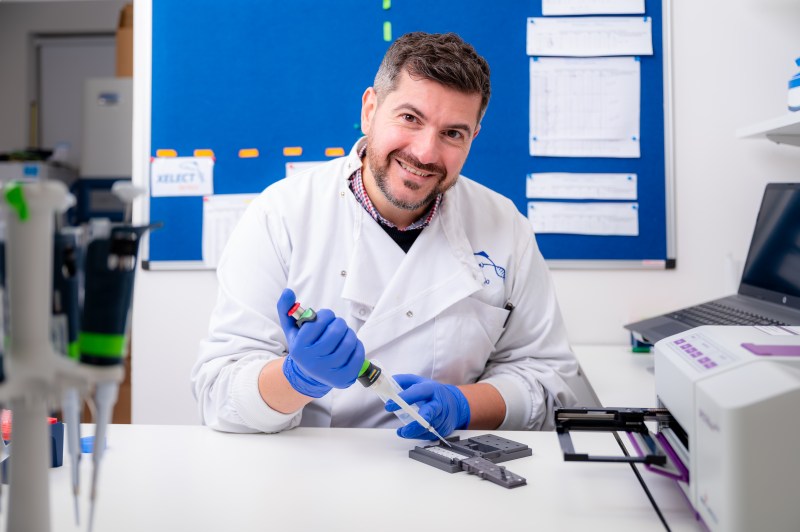
Paolo is a senior member of the Xelect Lab, bringing specialist expertise in population genetics, marine genomics and molecular biology. With hands-on experience in DNA extraction, library preparation and sequencing, he supports the smooth delivery of projects.
His practical problem-solving skills and deep technical knowledge allow the team to adapt quickly to different species, sample types and project requirements, giving clients confidence in the reliability and relevance of their results. Paolo also contributes to Xelect’s ongoing R&D and innovation work, supporting marker discovery and implementation of new tools that support better decision-making for breeding programmes.