
Fish gonads contain stem cells than can produce viable offspring when transplanted into sterile recipients (surrogates) of a related species. Surrogate broodstock technology (SBT) is transforming our scientific understanding of reproduction and sex determination and has important potential applications in conservation biology and aquaculture breeding.
A recent publication from the Institute of Marine Research in Norway has extended studies on SBT to one of the most commercially important aquaculture species, Atlantic salmon (Salmo salar). Cell suspensions were prepared from immature gonads of donor fish and injected into triploid (sterile) salmon at hatching. The donor cell suspensions contained many cell types including the all-important germinal stem cells (GSCs). Previous transplantation experiments with other fish species have shown that GSCs migrate to the germinal ridges of the surrogate whilst other cell types die (reviewed here).
Remarkably, the sex of the offspring is determined by the sex of the donor cells. Transplantation of spermatogonial cells into male surrogates produces sperm whereas female surrogates produce eggs. In the Norwegian study, transplantation experiments with cell suspensions from immature ovaries of Atlantic salmon were unsuccessful. As the authors state, this requires further investigation given similar experiments with rainbow trout yielding positive results.
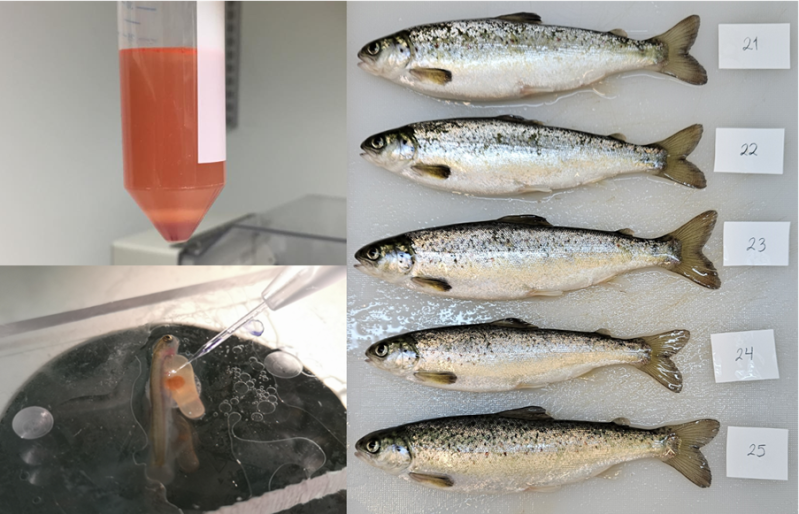
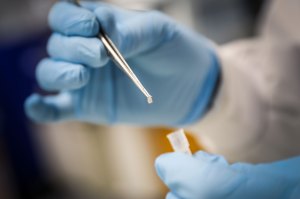
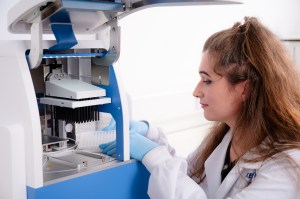
Fig. 1 Left top: Donor spermatogonial cell suspension is washed, centrifuged and filtered. Left lower: Donor cell suspension is injected into the triploid farmed salmon under a binocular microscope. Right: 10-month-old donor-derived offspring from a female surrogate.
I am grateful to Dr. Lene Kleppe and Tom Hansen, Institute of Marine Research, Matre Research station, Norway for providing the photographs.
In the study with Atlantic salmon, 5 mature males, and 3 mature females were obtained 3-years and 4-years post-transplantation respectively. All the maturing females had been fertilised with gonadal cells from male salmon and as a result the eggs they produced carry either X chromosomes or Y chromosomes (theoretically in a 1/1 ratio). When fertilised with normal salmon milt (X or Y) there was evidence that 1/3rd of the F1 offspring were YY-super males, confirming the potential of surrogate broodstock technology to produce highly desirable monosex populations (see also). F1 offspring of surrogates showed normal growth and survival (see Fig. 1 right).
Another aquaculture application suggested for SBT is non-conventional breeding. For example, this could include the dissemination of genetic material from elite individuals with extreme resistance to deadly diseases or parasitic infection, potentially cutting mortalities substantially. Back in 2007 a Japanese group obtained viable Masu salmon offspring from transplanted spermatogonial cells using rainbow trout as the surrogate. Theoretically, by using a related surrogate species with a shorter generation interval, the rate of genetic gain could be boosted for all key traits. Numerous studies have highlighted the potential of germ cell transplantation for the conversation of rare fish species or populations.
Why hasn’t surrogate broodstock technology been commercialised in mainstream aquaculture after many years of research? One possible explanation is that to date, few studies have explored the efficacy of the technology with the large number of fish needed to validate its application in large scale breeding. The type of quantitative data needed includes the efficiency of germ cell implantation, the percentage of offspring surviving, the proportion of adults becoming sexually mature and the yields and quality of the resulting eggs and sperm.
The recent study with Atlantic salmon does however provide some valuable insights. Males were much less successful as surrogates than females. Only 38% of larvae injected had fluorescently labelled donor cells in their testis 160 days post-transplantation. For those male surrogates that did mature, sperm quantity and quality was poor. It was suggested that competition from non-viable triploid sperm could provide part of the explanation. This is supported by experiments done in rainbow trout that were made germ cell free and sterile by knocking out the dead end 1 gene. Following germ cell transplantation, mature recipient individuals produced similar numbers and quality of eggs and sperm as wild type rainbow trout.
There are other problems though. Eggs size variation was found to be much higher from surrogate than normal Atlantic salmon. In some cases, recipient germinal cells only populated one of the ovaries as has been found in other species.
Crucially, the overall success of producing donor derived progeny from cell suspensions was 10% at best which is insufficient for most industrial uses. Whilst it is possible that these efficiency levels could be improved with further optimisation of techniques, there is still the problem of achieving the scaling necessary for commercial use. Future progress will require advances in the isolation, in vitro culture and fundamental understanding of stem cell biology.
Focus on stem cell biology
The “active” ingredient in spermatogonial cells suspensions are the stem cells (SSCs). These can self-renew to produce more stem cells or differentiate into daughter cells committed to differentiation and spermatogenesis. To counteract the low proportion of stem cells in spermatogonial/oogonial tissues, techniques for the isolation and long-term vitro culture of GSCs have been developed for several fish species (SSC studies reviewed here).
The stem cell component can be isolated based on their size, density and expression of specific surface markers. For example, antibodies to SSC surface proteins can be used in conjunction with fluorescence-activated or magnetic-activated cell sorting to enrich the proportion of stem cells for culture. Providing the correct mixture of nutrients and regulatory molecules in the culture medium, allows self-renewal and an enormous expansion of SSC numbers. An interesting approach for the in vitro expansion of rainbow trout SSCs, is the use of a feeder layer prepared from Sertoli cells and a culture medium containing trout plasma. The expanded SSC cultures showed similar stem cell activity in transplant experiments with surrogates and were just as successful at producing sperm, eggs and viable offspring (78-88% success rate) as freshly purified SSCs. There are also reports of a normal spermatogonial cell line isolated from Medaka fish with stable stem cell properties that was capable of producing motile sperm in vitro after 2 years in culture and 140 passages. These and other research on the long-term culture of SSCs opens the possibility of characterising and testing cell lines to produce the large numbers of cells needed for efficient transplantation over an extended period.
Oogonial stem cells (OSCs) have also been successfully isolated although attempts to perfect their long-term culture have proved much less successful than SSCs due to cell cycle arrest and metabolic dysfunction after relatively few passages. Further basic research on oogonial stem biology is clearly required prior to investment in aquaculture applications.
Future perspectives
SBT could potentially contribute to the advancement of conventional breeding by helping identify DNA regions coding for traits of commercial interest at the whole genome level. For example, the identification of genetic loci associated with resistance to disease or infection by parasites. The complex methodology proposed uses SBT to perform in vivo Genome-wide CRISPR Knock-Out (GeCKO) experiments and is well described here along with the research tasks still needed for its implementation.
There are also potential applications for germinal stem cells (GSCs) and surrogate technology in non-conventional fish breeding. Experiments with a frog species and chicken have shown that in some taxa Primordial Gem Cells (PGCs) can be edited directly using the CRISPR-CAS9 system and transplanted into recipients to produce homozygous progeny. If future research demonstrates that this is the case for farmed fish, then gene editing (GE) could be made much more efficient.
Currently, GE is achieved by the perinuclear microinjection of gene editing molecules into early-stage embryos. This results in founders with a mosaic of edited and non-edited cells as well as off-target edits that might produce unwanted phenotypes. Mosaicism is not expected to occur with gene edited GSCs. The screening of gene editing SSC lines for off target edits prior to transplantation could potentially also reduce the time and cost of obtaining regulatory approval, particularly if a surrogate with a shorter generation time than the target species was used.
Fish sperm can be cryopreserved and has many uses in fish breeding. In salmonids, cryopreserved sperm helps smooth performance differences between year-classes in each generation. It also enables direct measurement of genetic progress in a breeding programme by fertilising eggs from the current generation for comparison with eggs fertilised with sperm from the latest generation. The genetic gain is estimated as 50% of the difference in individual trait or index values.
A more accurate measure can be obtained by genotyping the fish with a high-density SNP chip to estimate the actual parental contribution of male and female genome in each cross. The ability to isolate and expand spermatogonial stem cells in vitro provides flexibility to the above applications. However, since the milt from a single male salmon can potentially fertilise hundreds of thousands of hen salmon, the use of SBT and GSCs to disseminate elite germplasm would not seem to be worth the trouble and expense. The only advantage would come from using a surrogate with a much shorter generation time such as sea trout (Salmo trutta) or rainbow trout (Oncorhynchus mykiss) to obtain a faster rate of genetic gain. For the large producers which use multiplier broodstock to scale production, a subsidiary breeding programme involving SBT might be worth considering because it would shorten the time it takes to transmit genetic gain from the nucleus to production fish.
Whilst fish sperm can be cryopreserved, eggs and embryos cannot. Many salmonid producers maintain a backup copy of the genetic nucleus on a separate site as an insurance policy to preserve their past investment in genetics. This is costly in terms of infrastructure, feed and labour. A possible alternative would be to cryopreserve oogonial and spermatogonial stem cells from each family enabling the entire genetic nucleus to be regenerated multiple times, albeit with a delay corresponding to the generation time of the chosen surrogate.
Exactly how knowledge of stem cell biology and surrogacy will be exploited remains a matter for debate, but at some point, I am convinced that these technologies will contribute to a revolution in aquaculture breeding.